2021 -- 2022
Beewise
Beekeeper management console for AI-powered, autonomous robotic beehives
Product Design, Interaction Design, Information Architecture, User Research, Hardware Design Contribution
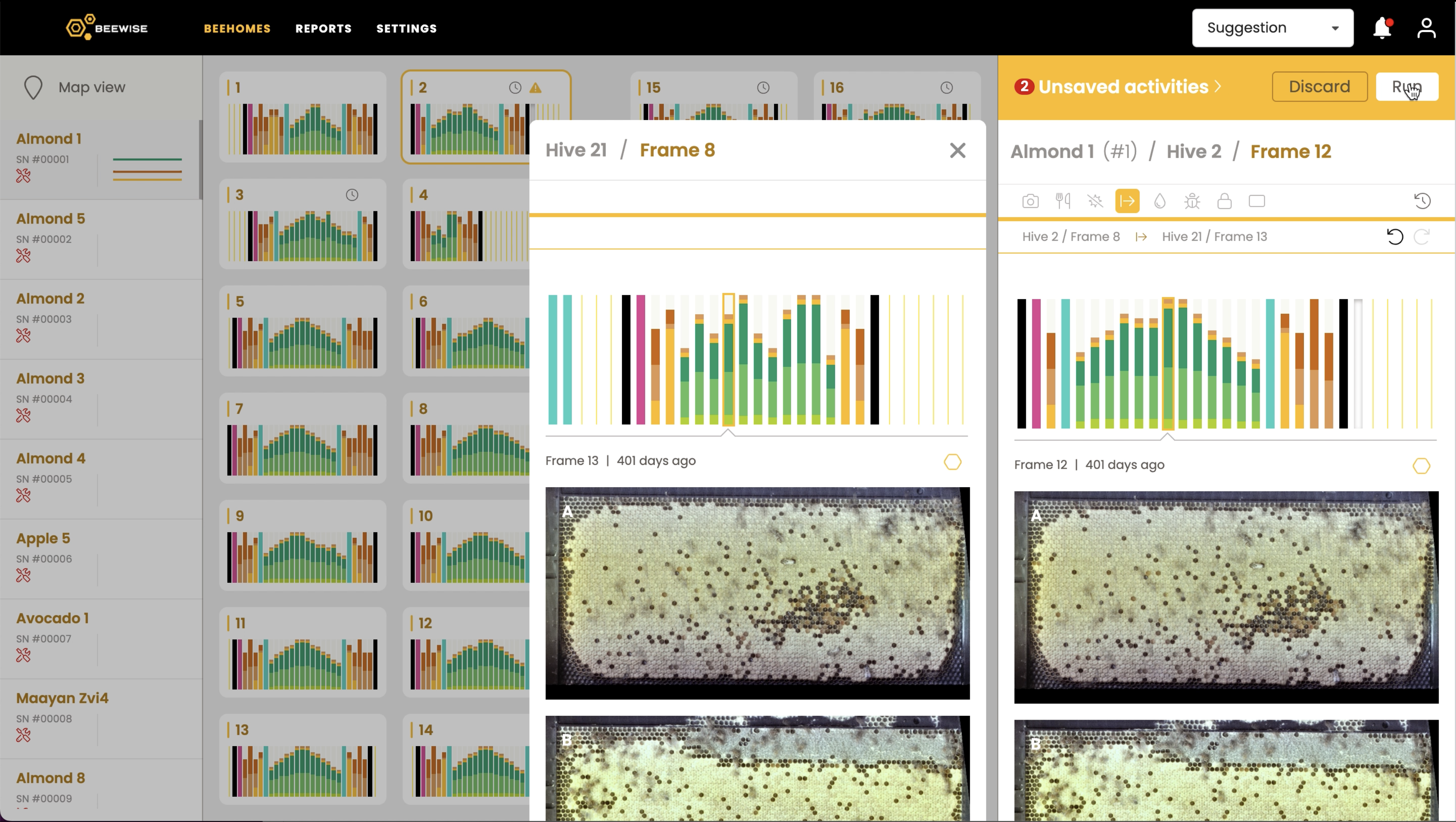
Beewise developed the BeeHome, an AI-powered autonomous robotic beehive designed to protect bee populations and prevent colony collapse. Using computer vision, AI, and robotics, it monitors hive health 24/7 and provides automatic real-time care -- feeding, pest control, and disease management -- reducing bee mortality by at least 75%.
This is a unique product that combines software, hardware, biology, and humans -- a rare intersection that demanded careful design thinking at every layer.
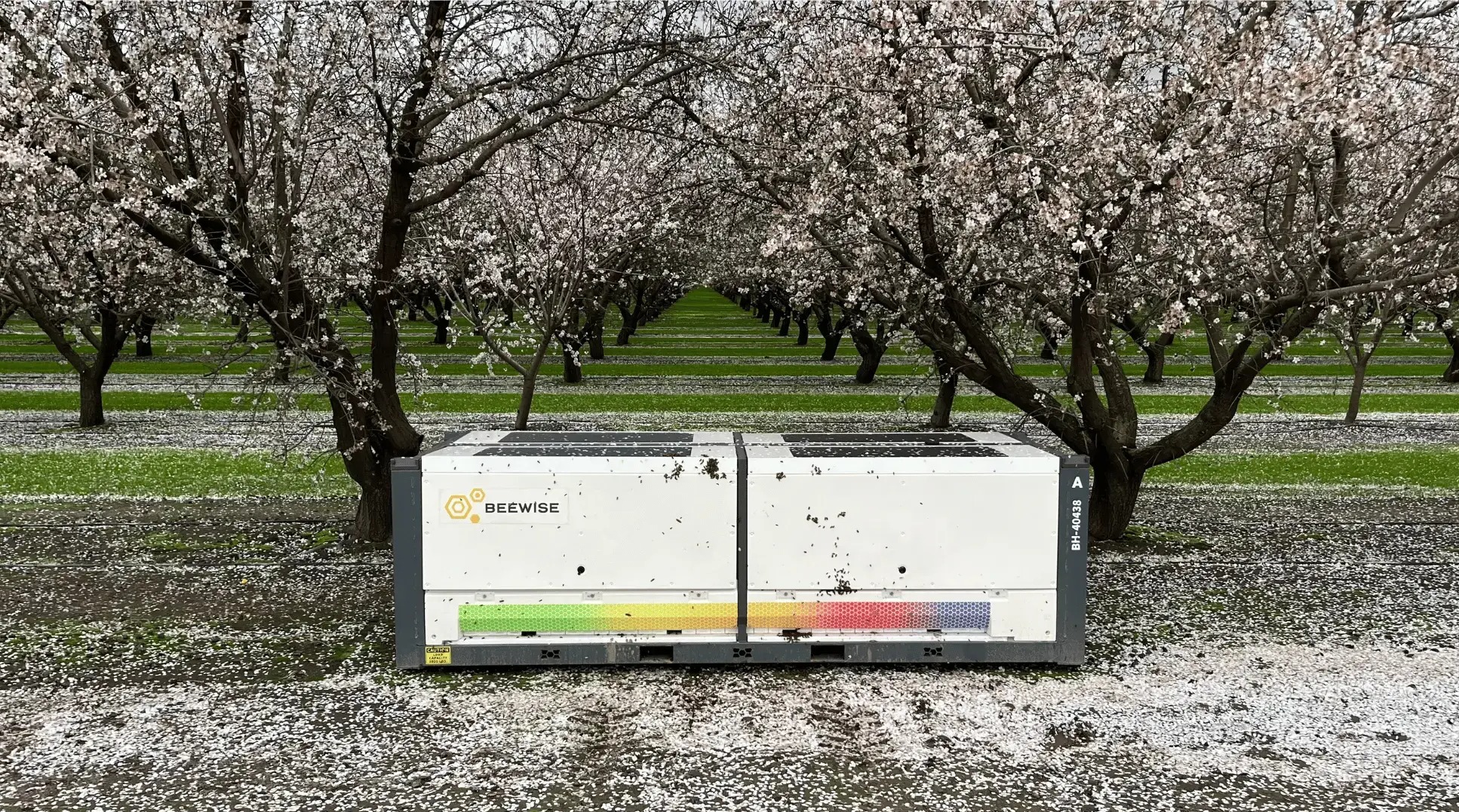
The BeeHome in an almond orchard -- a solar-powered, AI-driven robotic beehive housing up to 24 colonies
The Challenge
Design a first-of-its-kind, complex management system that -- after brief training -- feels intuitive to non-technical customers. Users range from small farmers to large beekeeping enterprises, typically early adopters curious about new technology, but far from technical people.
My Role
First in-house designer. Led the design of the beekeeper management console for fleet management of robotic beehives, plus an adjacent application for growers receiving pollination services. Also contributed design skills to mechanical, spatial, and robotics designs in the beehive itself.
Research & Context
Understanding beekeeping wasn't optional -- it was foundational. I spent time with pilot customers in their beekeeping operations and fields, visited our own hives regularly, and collaborated daily with the robotics and mechanical workshops and research biologists next door.
This immersion shaped every design decision. The product has numerous inherited challenges -- biological complexity, hardware constraints, environmental variables -- but the core UX challenge remained constant: make the complex feel approachable.
The Beekeeper App
The desktop-based management platform allows beekeepers to remotely monitor and maintain their fleet of robotic beehives. The interface focuses on three core workflows: high-level orchard management, detailed hive health diagnostics, and remote manual interventions.
Orchard & Hive Navigation
Geospatial Overview
The app features a map view displaying various orchards with icons representing individual robotic beehives. This spatial context is critical -- beekeepers think in terms of physical locations, not abstract lists.
Selection & Status
Users can select specific orchards from a sidebar to view hive distribution and operational status. The interface progressively discloses detail: from orchard overview, to hive selection, to frame-level inspection.
Health Monitoring & Diagnostics
Frame-by-Frame Analysis
The dashboard displays a grid of 24 frames for each hive, using color-coded bars to simulate hive frames and their contents, providing a bar-chart-like visualization. This mirrors how beekeepers traditionally inspect hives -- frame by frame -- but with data and speed they could never access before.
Visual Inspection
High-resolution imagery allows beekeepers to zoom into specific frames, inspecting honeycomb to the cell level, brood, and bee activity remotely. This is a powerful capability -- seeing inside a hive without disturbing the colony.
Automated Alerts
The system flags potential issues automatically -- such as "Looks like the queen is dead" -- prompting the user to investigate specific frames. These AI-driven insights turn reactive beekeeping into proactive colony management.
Remote Maintenance & Actions
Manual Logging
The "Beekeeper entries" section allows users to add logs with priority levels -- from "Just documenting" to "High" -- recording observations for future reference. This bridges digital monitoring with the beekeeper's institutional knowledge.
Robotic Actions
Users can queue specific robotic tasks: harvest frames, move frames between hives, treat for pests. These actions appear as "Unsaved activities" that the user can review before triggering the robotic hardware in the field.
Execution Control
The staged execution model -- select, review, run -- gives beekeepers confidence when commanding physical robots. Remote mistakes are costly; the interface respects that reality.
Cross-Disciplinary Contribution
While not my formal role, I contributed design thinking to mechanical, spatial, and robotics elements of the beehive itself. When software, hardware, and biology intersect, design can't stay in a single lane. Understanding the physical constraints informed the digital experience, and vice versa.